

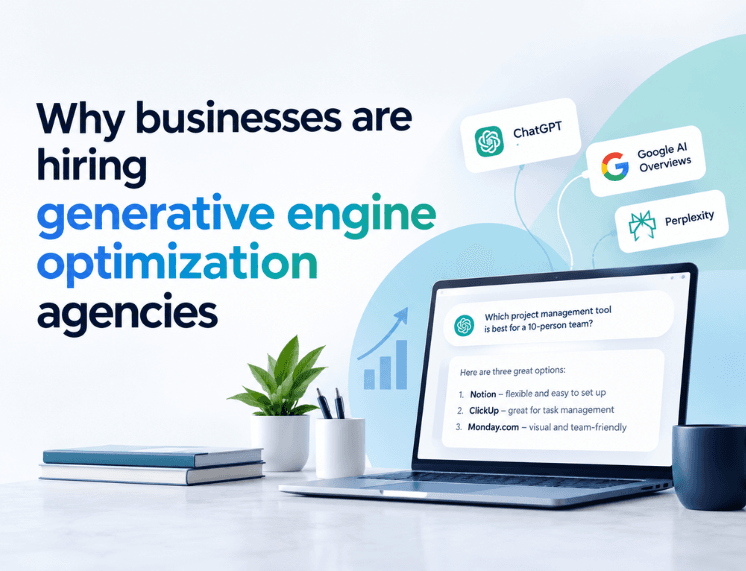
A customer asks ChatGPT which project management tool fits a 10-person team. ChatGPT gives three names. Yours is not one of them. That customer never sees your website, never runs a Google search, and never enters your funnel at all.
This is happening across industries right now, and it is why generative engine optimization agencies have moved from a niche service to a standard line item in marketing budgets. Businesses are not hiring these agencies because AI is trendy.
They are hiring them because a growing share of buying decisions now start and end inside an AI answer, with no click involved.
In short
Businesses hire generative engine optimization agencies because AI tools like ChatGPT, Google AI Overviews, and Perplexity now answer customer questions directly, often without a click to any website. Gartner projects traditional search volume will fall 25% by 2026. GEO agencies help brands get cited and recommended inside those AI answers, which traditional SEO alone was not built to do.
What actually changed in how people search
For twenty years, ranking on page one of Google was the goal. Ranking got you a click, and the click got you a customer. That chain is breaking.
Gartner predicted in February 2024 that traditional search engine volume would drop 25% by 2026, as generative AI tools become substitute answer engines that resolve a query without sending the user anywhere else (Gartner).
The data backing that prediction has arrived. Pew Research Center tracked the actual browsing behavior of 900 US adults and found that when Google shows an AI summary at the top of results, people click a traditional search result only 8% of the time. Without a summary, that click rate is 15%, almost double (Pew Research Center). Pew also found that people rarely click the source links inside the AI summary itself, so even being mentioned does not guarantee a visit.
Seer Interactive tracked over 3,100 search terms across 42 organizations between June 2024 and September 2025 and found organic click-through rate fell 61% for queries where an AI Overview appears, from 1.76% down to 0.61%. Paid click-through rate on those same queries dropped 68% (Seer Interactive). The same study found one detail that matters more than the rest: brands that are cited inside the AI Overview see meaningfully higher click-through rates than brands that are not cited at all, even on the same query.
Meanwhile, the AI tools themselves have gone mainstream fast. ChatGPT reached 900 million weekly active users by February 2026, more than double the 400 million it had a year earlier (Backlinko). That is not a niche audience anymore. It includes your customers, your prospects, and the people researching a purchase decision your business depends on.
Put these together, and the pattern is clear. Search has not disappeared. It has moved one layer up, into a conversation with an AI model that decides which brands get mentioned. If your brand is not part of that answer, you lose the customer before they ever reach your site.
What a generative engine optimization agency actually does
GEO agencies don't replace SEO. They add a layer on top of it that is built for how AI models select, summarize, and cite information.
A competent GEO agency typically works across three areas.
Content structure for machine comprehension. AI models pull short, self-contained, well-sourced statements more easily than long narrative paragraphs. GEO work restructures content so a model can extract a clean, accurate answer, usually through direct answer blocks, clear headings, and comparison tables placed near the top of a page.
Entity and authority signals. AI models weigh whether a brand is recognized as a credible source on a topic, not just whether a page ranks. This means consistent facts about your business across your website, directories, review platforms, and third-party mentions. It also means original data, expert commentary, and content that demonstrates real experience, since generic AI-generated filler gets deprioritized by the same models it was written to please.
Citation tracking and measurement. Traditional analytics tools were not built to show whether ChatGPT or Google AI Overviews mentioned your brand. GEO agencies use specialized tracking to monitor how often a brand appears in AI answers, in what context, and against which competitors, then adjust content based on what is and is not getting cited.
None of this is a one-time project. AI models weigh fresh content heavily for time-sensitive topics, so a page published in 2024 and never touched again will keep losing ground to a competitor's page from this year, even if the older page still ranks fine in traditional Google results.
Why most businesses cannot do this well in-house
A marketing team already managing SEO, social media, and content often assumes GEO is just an extension of the same skill set. In practice, three gaps show up quickly.
The first is measurement. Google Analytics and Search Console were not designed to show AI citations, so teams without dedicated tools are optimizing blind. They cannot tell whether a change helped, hurt, or did nothing.
The second is speed of change. AI platforms update how they select and rank sources far more often than Google updates its core algorithm, and there is no public changelog. Agencies that work across many client accounts see these shifts sooner because they are watching the pattern across a larger dataset, not just one website.
The third is discipline. GEO rewards a sustained publishing habit, original research, and regular content refreshes. Internal teams are usually already stretched across other priorities, and GEO is the first thing that gets deprioritized when a busier week hits.
What results to actually expect
An honest GEO engagement does not promise guaranteed placement inside every AI answer. No agency controls what ChatGPT, Gemini, or Google's AI Overviews choose to cite, and any agency that promises guaranteed rankings in an AI answer is not being straight with you.
What a reasonable engagement should deliver is a documented increase in citation frequency across tracked queries, clearer entity signals for your brand across the web, content that is measurably easier for AI systems to extract and quote, and month-over-month reporting that separates AI visibility from traditional SEO performance so you can see which channel is actually moving.
Timelines are similar to SEO. Early technical and content fixes can show up in citation tracking within four to eight weeks. Durable authority gains, the kind that make a brand a consistent, trusted answer across multiple AI platforms, tend to build over two to six months of consistent work.
Businesses comparing providers before committing budget often start with a third-party directory rather than vendor pitches alone. GoodFirms' list of top generative engine optimization companies is one place to compare agencies and client reviews, though any shortlist from a directory should still be checked against the questions above before signing a contract.
GEO versus traditional SEO at a glance
Traditional SEO | Generative engine optimization | |
Goal | Rank on the search results page | Get cited or recommended inside an AI answer |
Success metric | Rankings, organic clicks | Citation frequency, share of AI answers |
Content format | Long-form pages optimized for keywords | Direct answer blocks, structured data, clear entity facts |
Measurement tools | Google Search Console, rank trackers | AI visibility and citation tracking platforms |
Time horizon | Months to build authority | Weeks for technical gains, months for authority |
Still needed? | Yes, foundational | Yes, additive layer on top of SEO |
How Flaidex approaches this
At Flaidex, we believe strong AI visibility starts with a strong digital foundation. That's why we build websites and digital solutions that are fast, technically sound, and structured for both people and search engines.
As AI search becomes more important, we apply the same principles to our content. Every article on the Flaidex blog is built around real data, credible sources, and practical insights, without exaggerated claims or invented statistics.
Get in touch
If AI search is already changing how customers find your industry, waiting another quarter to address it only widens the gap between you and competitors who started earlier. Talk to Flaidex about where your brand currently stands in AI search results and what a realistic first quarter of GEO work would include.
Frequently asked questions
Is generative engine optimization the same as SEO?
No. SEO optimizes for ranking on a search results page. GEO optimizes for being cited or recommended inside an AI-generated answer. They share some techniques, like clear content structure and authority signals, but they target different outcomes and need separate measurement.
Do we still need SEO if we invest in GEO?
Yes. AI models still rely heavily on indexed, well-ranked content to decide what to cite. Seer Interactive's research found that dropping SEO in favor of GEO alone leaves a brand with a weaker base to be cited from in the first place. Treat GEO as additive, not a replacement.
How long does it take to see results from GEO work?
Technical and structural fixes can show up in citation tracking within four to eight weeks. Building durable authority that makes your brand a consistent answer across multiple AI platforms usually takes two to six months of sustained work.
Can a GEO agency guarantee our brand will appear in ChatGPT or Google AI Overviews?
No legitimate agency can guarantee this. AI platforms control their own citation logic and change it without notice. A credible agency will show you tracked citation frequency over time and be transparent that this is a directional, ongoing effort, not a fixed placement.
What size business actually needs a GEO agency?
Any business whose customers research purchases online before buying benefits from GEO, but the case is strongest for B2B services, SaaS, healthcare, financial services, and other industries where buyers ask detailed comparison questions that AI tools are well suited to answer.
How is GEO performance measured if it does not show up in Google Analytics?
Through dedicated AI visibility and citation tracking tools that monitor how often and in what context a brand appears across ChatGPT, Perplexity, Google AI Overviews, and similar platforms. A capable GEO agency should provide this reporting separately from standard SEO metrics.
Is GEO relevant for a company that mainly deals with Bangladesh clients?
GEO has grown fastest in the USA, UK, and European markets so far, but the same customer behavior- asking an AI tool instead of searching- is spreading everywhere content is written in English and buyers are research-heavy. Businesses that also sell internationally should not wait to start.
What is the biggest mistake companies make with GEO?
Treating it as a one-time content refresh instead of an ongoing practice. AI models weigh recent, regularly updated content heavily, so a GEO project that runs once and stops will lose ground within months to competitors who keep publishing and refreshing.