

Generative Engine Optimization (GEO) is the practice of shaping your content so AI assistants like ChatGPT, Gemini and Google AI Overviews quote it, cite it and describe your brand correctly when someone asks them a question.
It matters because a growing share of searches now end inside an AI answer, and the person asking never sees a list of links at all.
Think about the last time you looked something up. Did you type it into Google, or did you ask ChatGPT, Gemini or Bing?
Plenty of people now go to an AI tool first. They skip the ten blue links and get one structured answer back.
That changes the question for a business. Ranking on page one is no longer the whole job. If the AI answer doesn't mention you, the buyer who asked it may never hear your name.
That's the gap Generative Engine Optimization (GEO) covers. It extends SEO so your content ranks on Google and also gets cited inside AI-powered answers.
Below: what GEO is, where it overlaps with SEO and where it doesn't, how answer engines pick their sources, and the practical steps to start this week.
What is Generative Engine Optimization (GEO)?
GEO is optimizing your content so AI engines like ChatGPT, Gemini and similar tools can understand it, trust it and use it in their answers. Traditional SEO targets the Google results page. GEO targets the moment an AI tool answers a question and decides which brands and sources to mention.
The simplest way to see the difference:
SEO = competing for a place on a list of results.
GEO = competing to be part of the answer itself.
SEO taught us to write for a ranking algorithm. GEO asks you to write so clearly that a language model can lift a sentence from your page and trust it enough to quote.
GEO vs. SEO: Similarities and Differences
The two overlap more than the hype suggests, and the differences are worth knowing before you change anything.
1. How is GEO Similar to SEO?
GEO sits on the foundation SEO already built. They share a lot:
Both exist to get your brand found by the people looking for it.
Both reward content that is accurate, relevant and trustworthy.
Both depend on understanding intent: what the person actually wants to know.
Both work best on pages that are clear, well structured and easy to scan.
If your SEO is already solid, you've done half the GEO work.
2. How is GEO Different from SEO?
The differences come from how each engine delivers information:
Feature/Aspect | SEO | GEO |
Focus | Keywords, backlinks, technical health, ranking on Google SERPs | Clear structure, plain conversational language, credibility signals, and statements an AI can cite with confidence |
Traffic Metric | Clicks, rankings, impressions | AI citations, mentions in AI-generated answers, and whether the AI describes your brand accurately |
Primary Goal | More website traffic and higher search rankings | Being included, and trusted, in AI-powered answers |
Content Style | Written with search algorithms in mind | Written so a model can parse it and a person enjoys reading it |
SEO earns the click. GEO earns the mention.
3. Combining GEO with SEO
GEO doesn't replace SEO. It extends it.
A strong SEO foundation (fast pages, clean structure, real backlinks) is part of what makes an AI engine trust your content. Skip GEO, though, and you can rank well and still be missing from the answer. Do both: optimize for Google and for the assistants people ask.
Why GEO is Important in 2025 and Beyond
Search habits are shifting. For a lot of people, an AI tool is now the first place they go for a quick answer, and that's the whole case for Generative Engine Optimization (GEO).
Impact on Organic Search
Organic search isn't disappearing, but it's changing shape. More queries are answered on the results page or inside an AI response, which means less scrolling, fewer clicks and more "zero-click" searches.
Content that isn't GEO-friendly loses visibility here even when its rankings look healthy.
Evolution in User Search Behavior
What's changing in practice:
People "ask AI" before they "Google."
AI answers now shape product comparisons, shortlists and which brands a buyer trusts.
Younger audiences in particular expect a direct, conversational answer.
Treating GEO as optional now looks a lot like treating SEO as optional in 2005.
The Benefits of GEO
What a business actually gets out of it:
GEO Benefits in Action
Branded GEO: when someone asks an AI about your company, it gives them correct, current information: what you do, who you serve, what you cost.
Authority building: being cited in an answer tells the reader you're a source worth listening to.
Competitive edge: if a competitor hasn't done the work, the answer mentions you and not them.
Evaluated Tactics for GEO
Write key sections in question-and-answer format so an AI can lift a direct answer.
Keep sentences short and self-contained, so each one still makes sense when quoted alone.
Use headings, bullet points and plain definitions so the structure is obvious to a machine.
Support claims with data, research and named sources.
Visibility Improvements
With SEO alone, a good page can still sit on page two of Google. With GEO, the same page can be quoted inside the AI answer, which is where the reader looks first.
How Generative AI / Answer Engines Work
GEO makes more sense once you know roughly how an answer engine builds a response:
Semantic Search: the tool interprets the query by meaning, not by matching exact keywords.
Context Retrieval: it pulls candidate passages from its index or from a live web search.
Response Generation: a language model (like GPT) writes an answer from those passages.
Citation: sources that were clear and trustworthy enough to use get credited in the answer.
So keyword stuffing does nothing here. What helps is clarity, structure and authority: passages that are easy to retrieve and safe to quote.
How Does GEO Work in Practice?
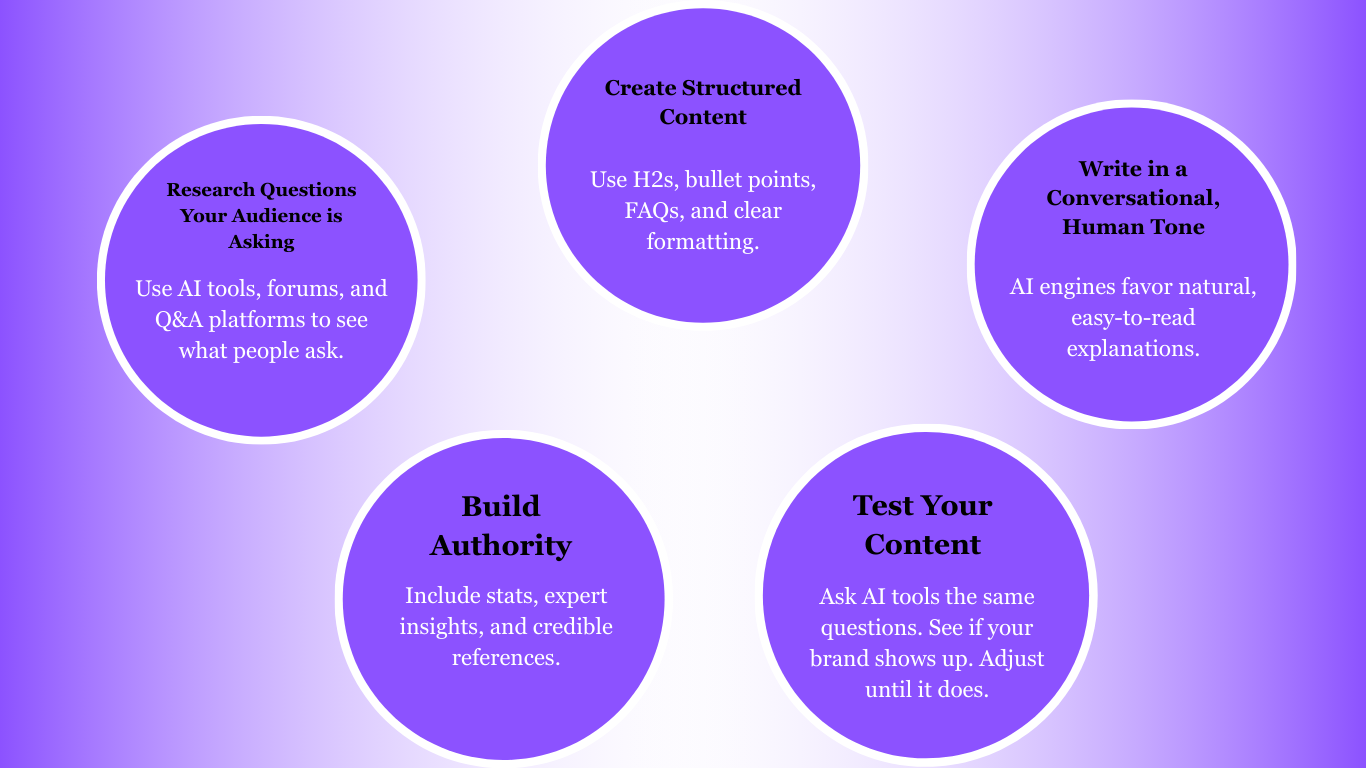
A step-by-step starting point:
Critique and Validation of GEO
Because GEO is new, some people call it SEO with a new label. That's partly fair:
GEO is an adaptation of SEO, not a replacement for it.
Industry voices such as Backlinko, Neil Patel, Search Engine Land and Writesonic now treat it as a discipline worth planning for.
The practical test is simple: ask the AI tools about your category and see whether you're in the answer.
The Future Potential of GEO
Where this is likely heading:
AI is changing search: as ChatGPT, Gemini and Bing become part of everyday search, GEO is how your brand stays in the answers people read.
Beyond simple answers: assistants are starting to suggest next steps and complete tasks, and they'll increasingly do it through voice and visuals as well as text.
Multi-format optimization: content will need to be readable by AI in every format you publish: text, images, video and audio.
Personalized experiences: answers will be tailored to each user's history and context. Content an AI can't parse won't make it into those answers.
GEO as a necessity: as AI becomes the layer between buyers and search results, GEO moves from nice-to-have to standard practice.
Competitive advantage: teams that start now build up the clear, citable content that later movers will have to catch up on.
How GEO and SEO Work Together
The short version:
SEO gets you found on Google.
GEO gets you mentioned in AI answers.
You need both to be visible wherever your buyers look.
You don't have to choose. The work overlaps, so do them together.
Final Thoughts
Google still matters, but it's no longer the only gatekeeper. AI engines now decide which answers people see first for a growing number of questions.
If those engines can't read your content, they'll describe your category without you. Generative Engine Optimization (GEO) is how you make sure your business shows up in the answer, not just somewhere in the search.
Where to start:
Keep your SEO fundamentals strong.
Rewrite your key pages so they answer questions directly.
Check what the AI tools say about you, and fix what's wrong.
Because from here on, SEO gets you discovered. GEO makes sure you're remembered.
FAQs
How can I start with GEO?
Pick the questions your buyers ask most, answer each one directly near the top of a page, use clear headings, cite reliable sources, then ask ChatGPT and Gemini the same questions to see if you appear.
What industries benefit most from GEO?
Healthcare, finance, e-commerce, real estate and education, because people ask AI tools a lot of questions in these areas before they buy or book.
Is GEO the future of digital marketing?
It's becoming a core part of it. As more search happens inside AI tools, GEO matters alongside SEO for staying visible.
Is GEO replacing SEO?
No. GEO builds on SEO. You still need strong SEO; GEO makes sure the same content also shows up in AI-generated answers.
Do I Need Tools for GEO Optimization?
No. Free tools such as AnswerThePublic (for finding the questions people ask) and Google PageSpeed Insights (for page health) are enough to begin. Paid AI tools can speed up the work, but they're optional.
AI-driven search is already here.
At Flaidex, we combine SEO and GEO so your business shows up in Google results and in the AI answers your buyers read.
Get found, get cited, and get described correctly.
Talk to us about your search visibility.