
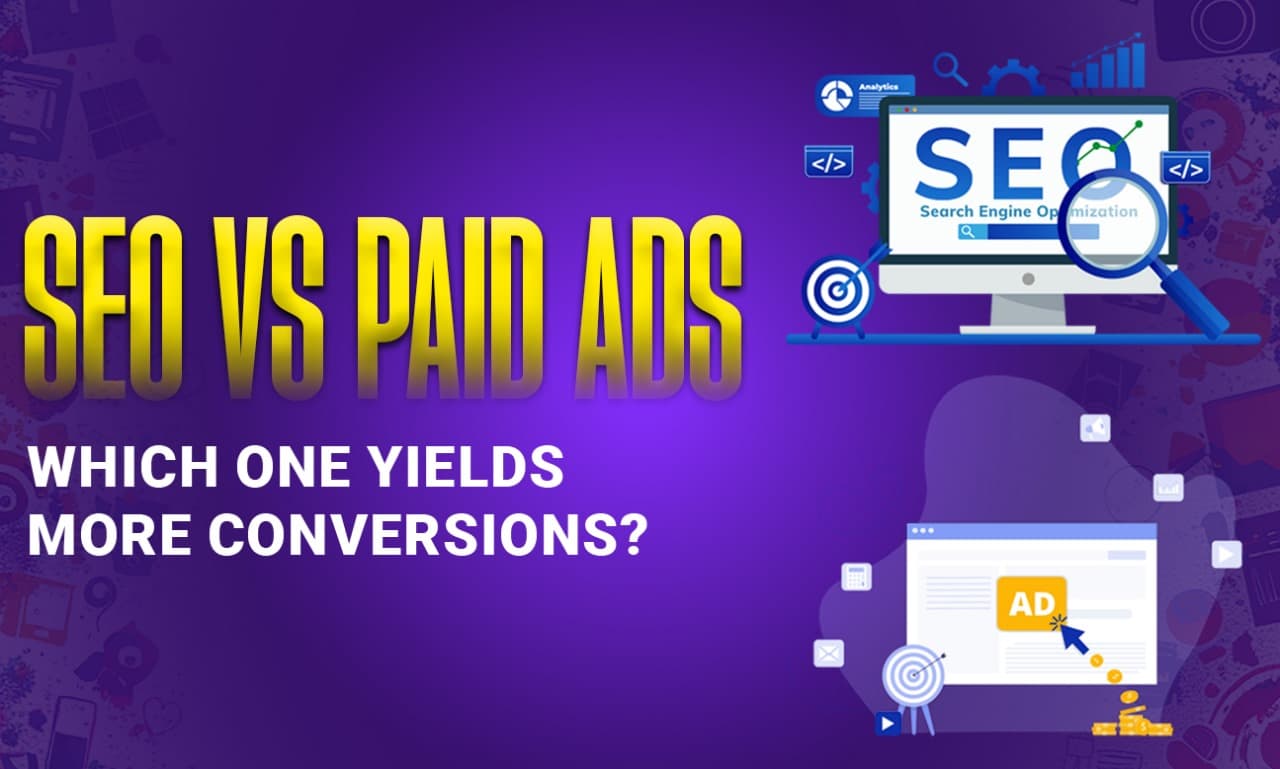
SEO or paid ads: which one brings in more conversions? The honest answer is that it depends on your budget, your timeline, your audience and what you need the marketing to do. Paid ads convert faster. SEO keeps converting long after you stop paying for clicks.
Each has real strengths and real limits, and the right mix changes with how much you can spend, how soon you need results, who you're selling to and what the business is aiming for.
This guide walks through how each one works, how each drives conversions, and how to decide where your money goes.
First, a quick look at what SEO and paid advertising actually are.
SEO is a long-term investment: it builds organic traffic and credibility that keep growing over time.
SEO (Search Engine Optimization): The Basics
What is SEO? SEO is the work of improving your site so it appears higher in organic (unpaid) search results. The goal is to bring in high-quality traffic by ranking for the keywords your buyers search on Google, Bing and Yahoo.
How SEO Works
SEO has three main parts:
On-page SEO: optimizing content, titles, meta descriptions, header tags and URLs around relevant keywords
Off-page SEO: link building, social signals and brand mentions, the icing on the cake
Technical SEO: making sure your site loads fast, works on mobile, gets indexed and is secure.
How does SEO affect conversion?
Quality of organic traffic: SEO attracts people who are actively searching for a solution.
Long-term growth: once you rank, the traffic costs almost nothing extra.
Trust and Credibility: users trust organic results far more than ads.
Now for paid ads.
Paid ads put you in front of potential customers immediately, which makes them the fastest route to conversions.
Understanding Paid Ads | PPC: Pay-Per-Click Advertising
What are Paid Ads?
With paid ads, a business pays to place advertisements on Google Ads, Facebook Ads, LinkedIn Ads, Instagram Ads or another ad network. If you pay per click, it's CPC; per thousand impressions, CPM; per conversion, CPA.
How Do Paid Ads Work?
Businesses bid on specific keywords or set targeting criteria. The ads appear in search results or social feeds, and the company pays for clicks, impressions or acquisitions.
How Paid Ads Affect Conversion
Traffic on tap: paid ads bring in visitors today. Precise targeting: ads can reach a specific demographic, location or interest.
But which one delivers better results?
SEO vs. PPC: which is better for conversions? Here are the strategies, pros and cons, and the best approach for different types of business.
SEO Strategies to Increase your Conversions
1. High-Intent Keyword Targeting
SEO works best when it targets high-intent keywords: searches from people who are ready to act. A local plumber ranking for "emergency plumber near me," for example, reaches people with an urgent problem, and those visitors are very likely to call.
2. Make Landing Pages SEO Friendly
Organic traffic is only the start. The job isn't finished until your landing pages are built to convert. That means:
A clear, direct call to action, for example "Get a Free Consultation Today!"
Loading speed: pages that load in under 2 seconds.
Mobile-friendly design: more than 60% of searches come from mobile devices.
A SaaS company, for example, should build a focused landing page with a strong CTA like "Start Your Free Trial Today" to turn more visitors into sign-ups.
3. Content Marketing and Building Authority
Much of SEO comes down to reputation. Useful, in-depth content builds trust, and trust is what gets people to convert.
Example: a fitness brand that publishes a thorough guide on "How to Lose Weight Safely" attracts health-minded readers, some of whom go on to become clients.
4. Local SEO for Targeted Conversions
For local businesses, local SEO is a big deal. A complete Google Business Profile, a steady flow of positive customer reviews and the right local keywords all turn searches into visits.
Example: a restaurant that ranks for "best pizza in Chicago" gets more walk-ins.
Paid Ads Strategies for Instant Conversion
1. Highly Targeted Campaigns
Paid ads can be targeted with real precision, for instance by:
- Demographics (age, gender and location)
- Interests and online behavior
- Very specific search keywords (as in Google Ads).
Ex: an e-commerce site selling luxury watches can reach people searching for "best Rolex alternative."
2. A/B Copy and Creative Testing
A/B testing shows you which ads work and lets you improve conversions from there.
Example: as a digital marketing agency, we might create two ad variations:
Ad A: "Get More Leads Today: Try Our SEO Services"
Ad B: "Rank #1 on Google: See Fast Results"
Then we compare click-through rates and conversions and use what we learn to shape future campaigns.
3. Remarketing Ads to Win Back Lost Leads
Very few visitors convert on their first visit. Remarketing ads bring them back.
Example: an online fashion store shows ads to shoppers who abandoned their cart, with a 10% discount if they complete the purchase.
4. Landing Pages Optimized for Traffic from Ads
Even the best ad won't convert if the landing page isn't optimized. Make sure that:
- The page carries the same message as the ad.
- There's a clear call to action (CTA).
- The page loads fast (slow pages kill conversions).
Example: a course platform runs Google Ads on the search term "Learn Digital Marketing in 30 Days" and sends clicks to a landing page with the course details and an "Enroll Now" button.
SEO versus Paid Ads: Which One Works Better for You?
Attributes | SEO (Search Engine Optimization) | Paid Ads (PPC Advertising) |
Cost | Lower long-term cost, but takes time | Higher cost for instant traffic |
Time to Results | Months to see results | Hours or days |
Sustainability | Traffic keeps growing over time | Traffic stops when the budget runs out |
Conversion Rate | Higher for buyers who research and need to trust you first | Higher for buyers ready to act now |
Most Suitable For | Companies focused on long-term growth | Companies that need leads or sales quickly |
Who Should Go for SEO?
Companies with a long-term view. Companies that want to build credibility and grow organic traffic. Local businesses that want to outrank competitors in local search.
Who Should Go for Paid Ads?
Companies that need leads or sales now. Startups launching new products or services. E-commerce stores targeting high-intent buyers.
The best approach: use both SEO and paid ads.
Use paid ads for short-term conversions, and invest in SEO for growth that gets cheaper over time. A smart way to combine them: use paid ads to find out which keywords convert, then build your SEO around those keywords.
FAQs
The cost of SEO and Paid Ads: which is cheaper?
SEO: cheaper in the long run, because organic traffic is free once you rank. It does take time to see results.
Paid ads: more expensive, because the costs (CPC, CPM, CPA) never stop, but they deliver immediate visibility and quick conversions.
How long does SEO take to work?
SEO usually takes 3 to 6 months to show visible results, depending on:
Competition: the more competitive the keywords, the longer the wait.
Website authority: new sites take longer; established ones rank faster.
Keywords & content: quality content, the right keywords and strong backlinks all matter. Patience and consistency are what make SEO pay off.
Not sure where to put your time and marketing budget?
It comes down to what matters most to you right now: immediate results or long-term returns.
Do paid ads work for e-commerce? Yes. Paid ads remain one of the most effective channels for online stores, for several reasons:
Instant traffic: paid ads, especially Google Shopping Ads and Facebook Ads, can bring buyers to an e-commerce store right away. These platforms let you target specific demographics, interests and buying behavior.
Conclusion
SEO and paid ads both earn a place in a serious marketing plan. SEO gives you the best return on steady, long-term traffic. Paid ads start converting almost immediately. Used together, they cover both the quick wins and the long game.
If you need conversions this month, start with paid ads. If you want traffic that keeps arriving without a click bill, invest in SEO. Most growing businesses get the best results by running both.
Want help working out the right mix for your business? Tell us what you're selling and who you're selling to, and we'll show you where the budget should go.